
 中文简体
中文简体

Product Consultation
Your email address will not be published. Required fields are marked *
Content
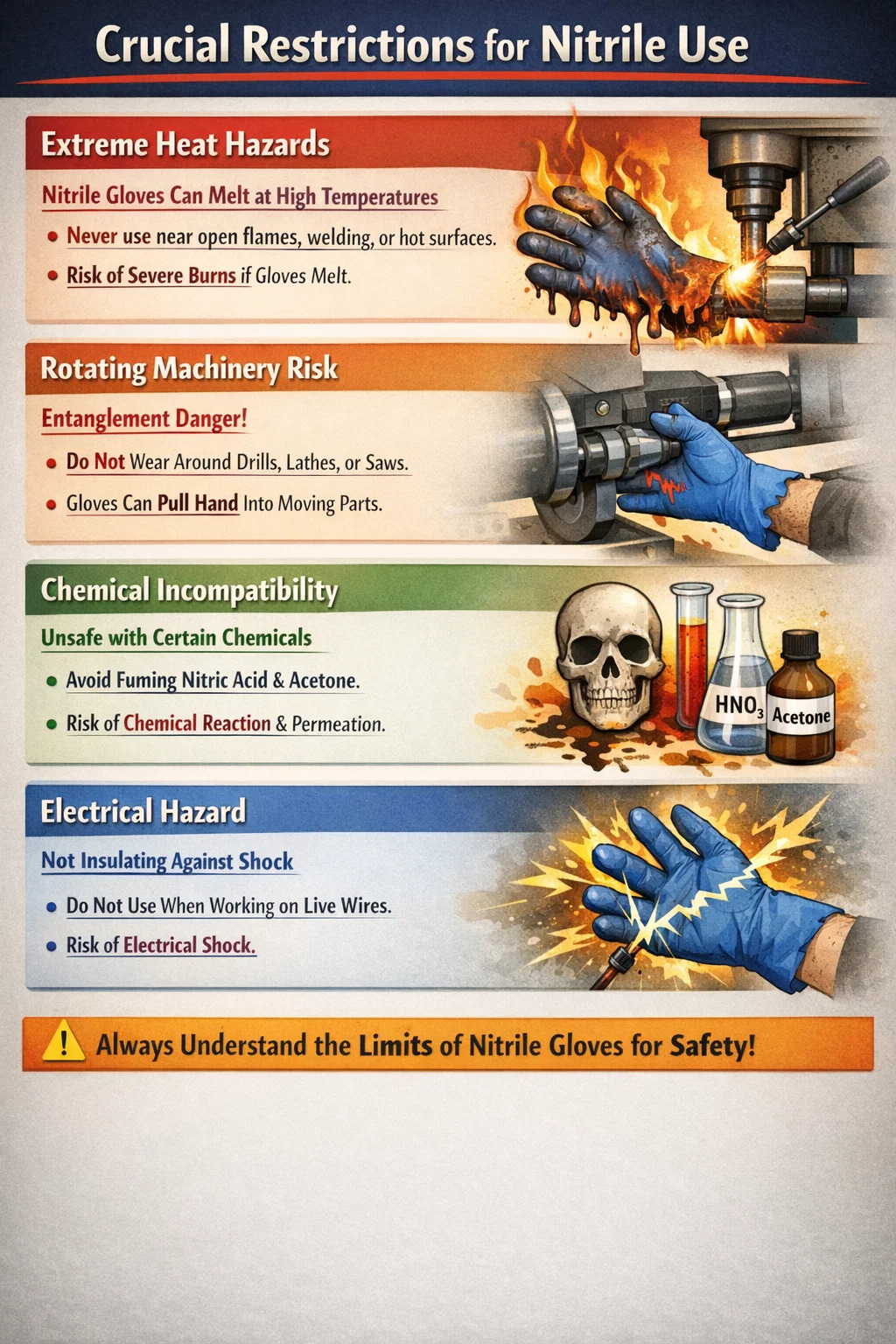
While nitrile gloves are the gold standard for many industries, you should not wear them when working with open flames, handling highly oxidizing acids, or operating rotating power machinery. These gloves are essentially a form of plastic (synthetic rubber); they will melt and fuse to your skin in high-heat scenarios and lack the "breakaway" strength needed to prevent your hand from being pulled into a spinning motor or lathe. Understanding these boundaries is vital for workplace safety.
One of the most dangerous mistakes is using nitrile gloves for heat protection. Nitrile is a thermoplastic elastomer, which means it responds to heat by softening and eventually melting. Unlike leather, which chars, or silicone, which resists high temperatures, nitrile can become a liquid-like adhesive when exposed to fire.
Most standard nitrile work gloves begin to degrade or lose structural integrity at temperatures exceeding 100°C (212°F). If you are welding, using a blowtorch, or reaching into a high-temperature oven, a splash of hot metal or a direct flame will melt the glove onto your hand, causing severe burns that are difficult for medical professionals to treat because the plastic must be surgically removed from the tissue.
In a machine shop or manufacturing plant, the durability of nitrile gloves actually becomes a liability. Because nitrile has high tensile strength and high friction, it does not "tear away" easily if caught in a moving part.
If you are operating a drill press, lathe, or table saw, wearing any glove—including nitrile work gloves—is often prohibited by OSHA standards. If a spinning bit catches a thread or the rubber surface, it will pull the entire glove, and consequently your hand, into the mechanism. The material is too strong to snap before the injury occurs.
| Activity Type | Nitrile Safety Status | Recommended Alternative |
|---|---|---|
| Operating a Lathe | Dangerous (Entanglement) | Bare Hands (per Safety Protocol) |
| Welding/Grinding | Dangerous (Melting) | Heavy-duty Leather |
| Handling Nitric Acid | Dangerous (Chemical Fire) | Fluorinated Elastomer (Viton) |
While nitrile gloves are famous for resisting oils and bases, they have "blind spots" when it comes to specific hazardous chemicals. Using them with the wrong substance can lead to rapid permeation or even a spontaneous chemical reaction.
You must not use nitrile when handling fuming nitric acid or concentrated sulfuric acid. These chemicals are strong oxidizers that can react exothermically with the synthetic rubber, potentially starting a fire on your hands. Furthermore, solvents like Acetone (Ketones) or MEK will permeate standard nitrile gloves in seconds, causing the glove to swell and degrade, allowing the toxin to reach your skin instantly.
Standard nitrile work gloves are not designed to be electrical insulators. While they are made of rubber-like material, most industrial variants are too thin to provide any protection against high-voltage shocks.
Wearing nitrile work gloves while working on a live electrical panel can give a worker a false sense of security. If the glove is sweaty or has microscopic punctures, it can facilitate an electrical arc. Electricians must use ASTM-rated rubber insulating gloves that are specifically tested for dielectric strength, never basic nitrile.
In some specialized food or medical settings, nitrile gloves can become a hazard if they are not used correctly or changed frequently. They are a "barrier," not a "disinfectant."
Although nitrile is latex-free, it is not always "reaction-free." Some people suffer from Type IV hypersensitivity, which is a reaction to the chemical accelerators (like thiurams or carbamates) used to stabilize the nitrile work gloves.
If a worker has active eczema, open sores, or a diagnosed allergy to rubber accelerators, wearing nitrile can exacerbate the inflammation. In these cases, one should look for "accelerator-free" nitrile gloves or use a cotton liner underneath to absorb sweat and prevent direct contact with the synthetic material.
Your email address will not be published. Required fields are marked *
You can contact to me using this form.