
 中文简体
中文简体

Product Consultation
Your email address will not be published. Required fields are marked *

Content
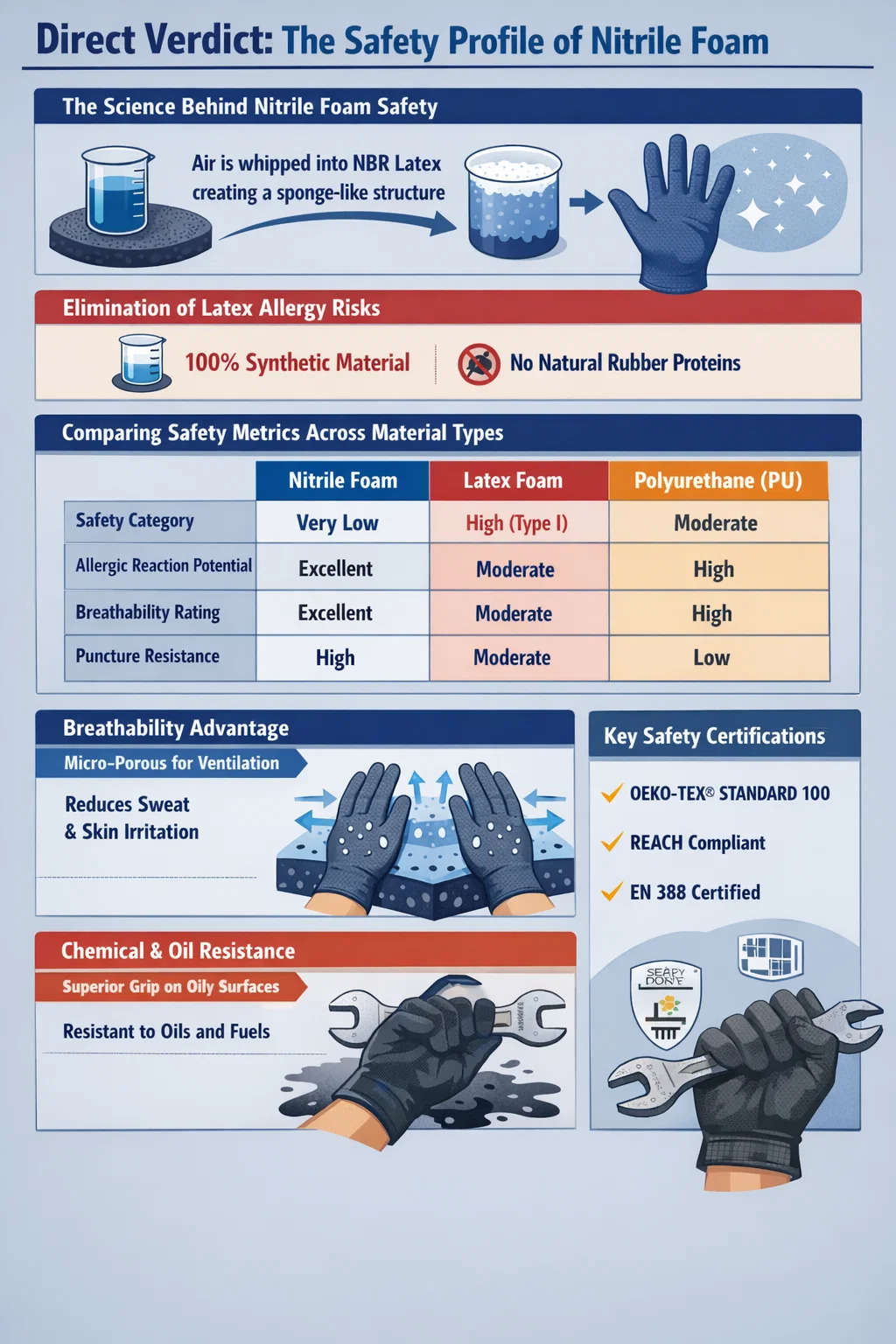
To answer the question directly: Yes, nitrile foam is exceptionally safe for the vast majority of people and is often the preferred choice for those with sensitive skin. Because it is a 100% synthetic material, it contains none of the natural rubber proteins that cause latex allergies. Furthermore, nitrile foam is chemically inert once cured, meaning it does not release toxic fumes or harmful residues during standard use, making it an industry standard for protective gear.
Nitrile foam is created through a specific manufacturing process where air is whipped into the nitrile butadiene rubber (NBR) latex before it is applied to a glove liner. This results in a cellular structure that mimics a sponge on a microscopic level.
One of the biggest safety hurdles in industrial hand protection has been the prevalence of Type I latex allergies. Nitrile gloves and foam-coated variants offer a definitive solution. Since they are made from a petroleum-derived copolymer of acrylonitrile and butadiene, they lack the organic proteins that trigger severe immune responses, making them safe for "universal" use in diverse workforces.
Understanding the safety of nitrile foam requires a comparison with other common coating materials like Polyurethane (PU) or Latex. The table below highlights how nitrile stands out in terms of user health and protection.
| Safety Category | Nitrile Foam | Latex Foam | Polyurethane (PU) |
|---|---|---|---|
| Allergic Reaction Potential | Very Low | High (Type I) | Moderate (DMF risk) |
| Breathability Rating | Excellent | Moderate | High |
| Puncture Resistance | High | Moderate | Low |
Safety isn't just about what is in the material, but how the material affects your physiology. When hands are trapped in non-breathable gloves, sweat accumulates, leading to skin maceration—a state where skin softens and becomes vulnerable to infections and irritants.
The "foam" in nitrile foam acts like a ventilation system. The microscopic pores allow air to reach the palm, keeping hand temperature lower and significantly reducing sweat buildup. For a worker wearing gloves for 8 to 10 hours a day, this breathability is a crucial safety feature that prevents long-term dermatological issues.
A key aspect of safety is whether nitrile gloves can protect the wearer from external hazards. Nitrile is naturally more resistant to oils, fuels, and certain solvents than latex or vinyl.
In mechanical work, nitrile foam is particularly safe because the foam structure "wicks" oil away from the surface. This creates a "suction" effect, giving the wearer a firm grip on oily tools. A stable grip is a primary safety requirement to prevent dropping heavy machinery or slipping while using cutting tools.
To ensure the nitrile foam you are using is truly safe, you should look for specific industrial certifications on the packaging. These labels indicate the material has been rigorously tested for harmful chemicals and physical durability.
While nitrile foam is safe for general purpose and mechanical work, it is not a "magic shield." Safety also depends on knowing when not to use it.
Because the foam is porous to allow for air, it is also porous to liquids if they are pressurized or if the hand is fully submerged. For heavy-duty chemical dipping (like handling concentrated acids), a solid nitrile glove is necessary. Using foam in a submerged chemical environment is unsafe as the liquid can eventually permeate the foam and sit against the skin.
Nitrile is a thermoplastic. While it handles moderate friction heat well, it is not designed for fire or extreme high-temperature handling. If exposed to a flame, it will melt, which can lead to severe skin burns. Always use leather or specialized aramid fibers for heat-related tasks.
When chosen correctly and used for its intended purpose—such as construction, automotive repair, logistics, or general maintenance—nitrile foam represents one of the safest intersections of skin health and mechanical protection available today. Its lack of latex proteins, high breathability, and stability under oily conditions make it a cornerstone of modern hand safety.
Your email address will not be published. Required fields are marked *
You can contact to me using this form.