
 中文简体
中文简体


Product Consultation
Your email address will not be published. Required fields are marked *

Content
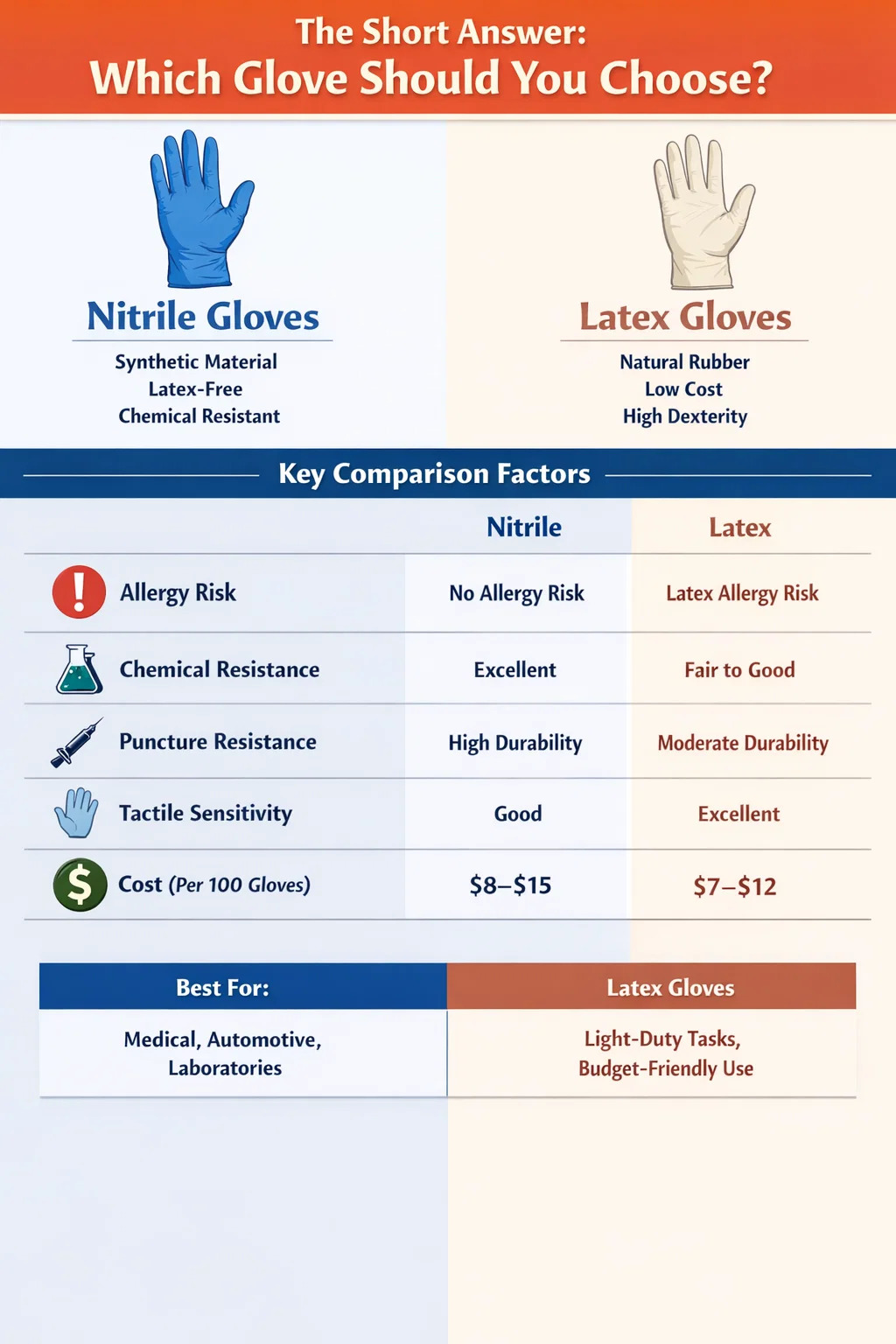
Nitrile gloves and latex gloves serve similar purposes but differ significantly in material composition, allergy risk, chemical resistance, and cost. If you or those around you have latex allergies, nitrile gloves are the clear choice. If cost is the primary concern and allergies are not a factor, latex gloves may still be suitable for light-duty tasks. For most professional environments today — including medical, automotive, and laboratory settings — nitrile gloves have become the dominant standard, and for good reason.
Understanding the specific differences between these two glove types helps you make a smarter purchase decision, whether you're stocking a medical clinic, a tattoo studio, a mechanic's shop, or a home first-aid kit.
Latex gloves are made from natural rubber latex, a substance harvested from the Hevea brasiliensis tree, commonly known as the rubber tree. This natural material contains proteins that give latex its elasticity and tactile sensitivity — but those same proteins are also responsible for triggering allergic reactions in some individuals.
Nitrile gloves, by contrast, are made from acrylonitrile butadiene rubber (NBR), a fully synthetic material. There are no natural proteins in nitrile, which is exactly why it does not cause latex-type allergies. The synthetic composition also gives nitrile a fundamentally different performance profile compared to latex — particularly in terms of chemical resistance and puncture resistance.
The manufacturing process for each material also differs. Latex gloves are dipped in natural rubber compounds and tend to have a more uniform thickness throughout. Nitrile gloves require more complex chemical processing, which historically made them more expensive — though that gap has narrowed considerably over the past decade.
One of the most important distinctions between nitrile and latex gloves is the allergy risk associated with latex. According to the American Latex Allergy Association, approximately 1–6% of the general population has a latex allergy, while the rate among healthcare workers can reach as high as 17% due to frequent exposure over time.
Latex allergy symptoms range from mild skin irritation and contact dermatitis to severe anaphylactic reactions. For this reason, many hospitals, dental offices, and food processing facilities have adopted latex-free policies across their entire operations. In these environments, nitrile gloves are not optional — they are mandatory.
Even individuals who don't currently have a latex allergy can develop one with repeated exposure. This sensitization process can happen gradually over months or years. Once sensitized, even brief contact with latex products can provoke a reaction. Nitrile gloves carry no equivalent risk, making them a safer long-term choice for anyone who uses gloves frequently.
There is also the consideration of patient safety. A healthcare provider wearing latex gloves who treats a latex-sensitive patient can trigger a reaction simply through contact. This cross-contamination risk is entirely eliminated when nitrile gloves are used.
When it comes to protection against chemicals, nitrile gloves offer substantially better resistance than latex across a wide range of substances. This is one of the primary reasons nitrile gloves dominate in industrial, automotive, and laboratory environments.
Nitrile is highly resistant to oils, greases, fuels, many solvents, and a broad range of chemicals including acetone, ethanol, and various acids and bases (depending on concentration and exposure duration). Latex, while offering some chemical protection, degrades more readily when exposed to petroleum-based products and many organic solvents.
The table below summarizes how nitrile and latex gloves compare in resistance to common substances:
| Substance | Nitrile Gloves | Latex Gloves |
|---|---|---|
| Motor oil / grease | Excellent | Poor |
| Gasoline / fuel | Good | Poor |
| Dilute acids | Good | Fair |
| Alcohols | Good | Good |
| Acetone | Fair | Poor |
| Bleach / disinfectants | Good | Good |
| Biological fluids | Excellent | Excellent |
For tasks involving petroleum products or industrial chemicals, nitrile gloves are the only practical option. Using latex gloves in these environments not only provides inadequate protection but can actually accelerate degradation of the glove material, creating a false sense of safety.
Nitrile gloves are generally 3 to 4 times more puncture-resistant than latex gloves of comparable thickness. This is a significant advantage in environments where sharp objects, needles, or rough surfaces are common hazards — such as in phlebotomy, surgery, tattoo artistry, or general construction work.
Latex gloves are more elastic and conforming, which gives them better initial tear resistance in some scenarios — they tend to stretch rather than rip when snagged. However, once punctured, a latex glove provides no barrier protection at the puncture site. Nitrile, being less elastic, is more likely to resist piercing altogether.
In medical settings where needlestick injuries are a concern, the added puncture resistance of nitrile gloves provides a meaningful, though not absolute, layer of protection. No disposable glove — nitrile or latex — is designed to prevent deep punctures from hypodermic needles, but nitrile does offer more resistance to surface abrasion and minor piercing.
For tasks like handling sharp sheet metal, working with glass, or processing thorny plant material, heavier-gauge nitrile gloves (6 mil or thicker) offer substantially better hand protection than standard latex exam gloves.
Historically, latex gloves were preferred for tasks requiring fine motor control because of their superior elasticity and natural fit. Latex conforms closely to the hand's contours, providing a second-skin feel that surgeons and dental professionals valued highly for precise work.
Older nitrile formulations were stiffer and less comfortable for extended wear. However, modern nitrile gloves have closed this gap dramatically. Current thin-film nitrile gloves (3.5 mil or less) offer tactile sensitivity and flexibility that rival latex. Many healthcare professionals now report they cannot distinguish between well-made thin nitrile and latex gloves during normal use.
The key difference in feel comes down to elasticity. Latex stretches and snaps back; nitrile is slightly more rigid but still conforms well to hand shape. For most everyday applications — from cleaning to food prep to basic medical examinations — this difference is negligible. For highly specialized surgical procedures requiring maximum tactile feedback, latex may still hold a slight edge, though high-quality surgical nitrile gloves have become widely accepted even in operating rooms.
Fit is also influenced by glove thickness. Nitrile gloves are available in a wider range of thicknesses — from ultra-thin 2 mil exam gloves to heavy-duty 8 mil industrial gloves — giving users more options to match the glove to the task than latex typically allows.
For years, latex gloves were significantly cheaper than nitrile — sometimes by 30–50% per box. This price difference was a major reason many facilities stuck with latex even as allergy awareness grew. That pricing landscape has changed substantially.
As of recent years, a box of 100 nitrile exam gloves typically retails between $8 and $15, while latex gloves are priced similarly at $7 to $12 per box of 100. The gap has narrowed enough that for most buyers, cost is no longer a compelling reason to choose latex over nitrile.
Factors driving the price convergence include increased global nitrile manufacturing capacity (particularly in Malaysia, which produces a significant portion of the world's nitrile gloves), greater demand driving economies of scale, and competitive pressure from suppliers.
It's worth noting that specialty nitrile gloves — such as extra-thick industrial gloves, sterile surgical gloves, or chemotherapy-rated gloves — do carry a premium. But for standard disposable exam or work gloves, the cost difference between nitrile and latex is minimal in most markets.
Both nitrile and latex gloves have historically been available in powdered and powder-free versions. Cornstarch powder was used inside gloves to make them easier to don and doff. However, the FDA banned powdered latex gloves in the United States in January 2017, citing risks including airway inflammation, wound inflammation, and post-surgical adhesions.
Powdered nitrile gloves are still available but are rarely used in medical settings. In industrial applications, powder-free nitrile gloves are standard because powder residue can contaminate sensitive work surfaces or products.
When shopping for gloves today, powder-free nitrile gloves are by far the most commonly available and recommended option for virtually all use cases. If you see powdered gloves listed, it is worth questioning whether they are appropriate for your specific application.
From an environmental standpoint, latex gloves have one notable advantage: they are made from natural rubber, which is biodegradable under the right conditions. Natural latex can break down in composting environments, although this process is slow and requires specific microbial conditions not present in standard landfills.
Nitrile gloves, being synthetic polymers, do not biodegrade readily and contribute to plastic waste when disposed of in landfills. An estimated 300 billion disposable gloves are used globally each year, and the vast majority end up in landfills or, worse, as environmental litter.
Some manufacturers have introduced biodegradable nitrile gloves that use proprietary additives to accelerate breakdown in landfill environments. Independent verification of these claims varies, and this category of product is still evolving.
For buyers who prioritize environmental impact, latex gloves may present a marginally greener option for low-risk applications — provided allergy concerns are not a factor. For high-risk environments where durability and chemical resistance matter, the functional advantages of nitrile generally outweigh the environmental consideration.
The right glove depends heavily on what you're doing. Below is a practical breakdown by application:
Nitrile gloves are now the standard in most healthcare settings due to their allergy-safe profile, strong barrier protection against bloodborne pathogens, and good chemical resistance to disinfectants and medications. The FDA classifies both nitrile and latex exam gloves as Class II medical devices, meaning both meet regulatory standards for barrier protection — but nitrile avoids the allergy issue entirely.
Nitrile gloves are the only practical choice here. Motor oil, brake fluid, transmission fluid, and gasoline will degrade latex quickly. Mechanics typically use heavier 6–8 mil nitrile gloves for durability, often in black or dark blue to mask grease staining during work.
Both nitrile and latex gloves are used in food service, but nitrile is preferred for two reasons: latex proteins can transfer to food and trigger reactions in sensitive diners, and many state health codes now require latex-free environments in commercial kitchens. Vinyl gloves are also common in food service for low-risk tasks due to their very low cost.
Nitrile gloves are strongly preferred in laboratories due to their chemical resistance profile. For work involving biological specimens, common reagents, and most organic solvents, nitrile provides better protection. However, for tasks involving highly concentrated acids or certain chlorinated solvents, neither nitrile nor latex is sufficient — more specialized gloves are required.
Nitrile gloves are the industry standard in tattooing. Given that the artist is working with open skin and blood, latex-free protection is critical to protect both artist and client. Many tattoo studios also prefer black nitrile gloves for aesthetic reasons, as they don't show ink staining during sessions.
Either nitrile or latex can work for general cleaning, but nitrile is more resistant to the bleach-based and solvent-based cleaners commonly used in commercial settings. For household cleaning involving milder products, latex or even vinyl gloves may be sufficient.
Glove thickness is measured in mils (thousandths of an inch) and is a key factor in both protection level and dexterity. Understanding thickness helps you match the glove to the task:
Latex gloves are most commonly available in the 3.5–5 mil range. Nitrile gloves span the entire range from 2 mil to 8 mil and beyond, giving users far more flexibility in choosing the right protection level for their specific task.
The following table summarizes the key differences between nitrile and latex gloves across the most important performance and practical factors:
| Factor | Nitrile Gloves | Latex Gloves |
|---|---|---|
| Material | Synthetic (NBR) | Natural rubber |
| Allergy risk | None | Yes (protein allergy) |
| Chemical resistance | Excellent | Fair to Good |
| Puncture resistance | High | Moderate |
| Elasticity / fit | Good (modern formulas) | Excellent |
| Tactile sensitivity | Good | Excellent |
| Cost (per 100 gloves) | $8–$15 | $7–$12 |
| Biodegradability | Low | Moderate |
| Thickness range | 2–8+ mil | 3–5 mil (typical) |
| Oil / petroleum resistance | Excellent | Poor |
Given nitrile's advantages across most categories, it's worth asking: is there any scenario where latex gloves are still the better choice? The answer is yes, in a few specific situations.
These are genuine but relatively narrow use cases. For the majority of applications and users, the combination of allergy safety, chemical resistance, and competitive pricing makes nitrile gloves the more practical default choice.
Once you've decided on nitrile, there are still meaningful differences between products to consider. Here's what to look for:
Getting the right specification matters more than many buyers realize. An undersized or under-rated glove fails to protect; an over-specified one wastes money and reduces dexterity unnecessarily.
What Should You Not Use Nitrile Gloves For? Key Limitations
What is the difference between PU and nitrile gloves?
Your email address will not be published. Required fields are marked *
You can contact to me using this form.