
 中文简体
中文简体
Product Consultation
Your email address will not be published. Required fields are marked *
Content
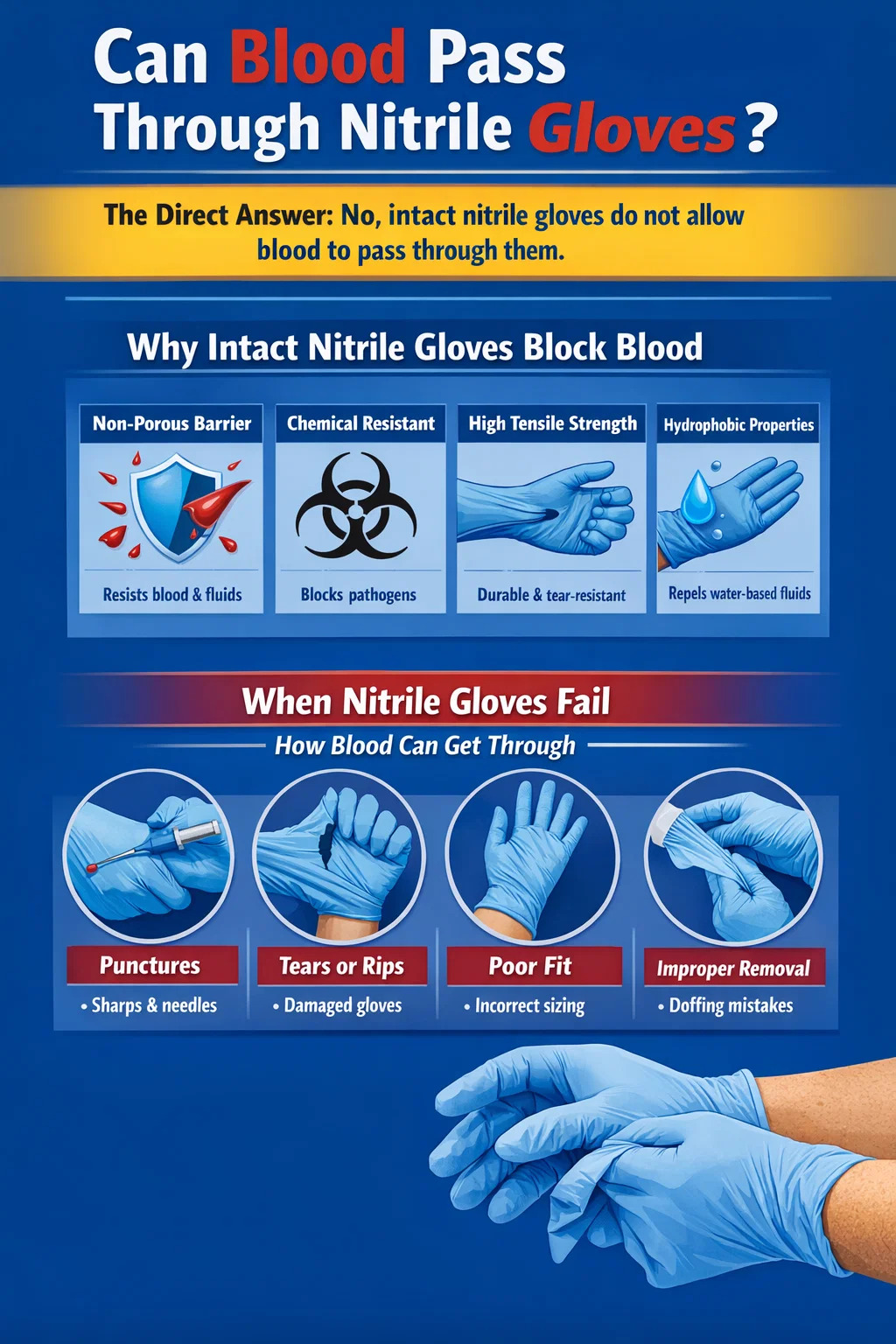
Under normal conditions, intact nitrile gloves do not allow blood to pass through them. Nitrile rubber is a dense, synthetic material that forms a continuous barrier against liquids, including blood and other bodily fluids. This is one of the primary reasons nitrile gloves have become the dominant choice in medical, laboratory, and emergency response settings worldwide.
However, the word "intact" carries enormous weight in that statement. Blood — or the pathogens it may contain — can reach your skin if a glove is torn, punctured, has an undetected manufacturing defect, or is used incorrectly. The glove material itself does not absorb or allow passive permeation of blood under standard use conditions, but physical breaches change everything.
This article breaks down the science behind nitrile's barrier properties, the real-world failure points you need to know about, how nitrile compares to latex and vinyl, and the correct protocols for putting on and removing gloves without contaminating yourself in the process.
Nitrile butadiene rubber (NBR) is a synthetic copolymer made from acrylonitrile and butadiene. Unlike natural rubber latex, it contains no plant-derived proteins, which eliminates the risk of Type I latex allergy — a significant concern in clinical environments. The molecular structure of nitrile is tightly cross-linked during vulcanization, creating a non-porous film that is highly resistant to oils, chemicals, and aqueous liquids like blood.
The key properties that make nitrile gloves effective against blood are:
Blood is mostly water (about 55% plasma by volume), with suspended cells and proteins. Because nitrile is hydrophobic and structurally non-porous, it repels water-based fluids and prevents their passive movement through the film. This is fundamentally different from, say, a porous fabric, where liquid can wick through by capillary action.
Not all nitrile gloves are created equal. Thickness — measured in mils (thousandths of an inch) — directly influences the glove's puncture resistance and durability. Thicker gloves provide a wider margin of protection in high-risk environments, but they reduce tactile sensitivity, which matters for surgical or fine-motor tasks.
| Glove Type | Typical Thickness (mils) | Common Use | Puncture Resistance |
|---|---|---|---|
| Exam-grade nitrile (thin) | 2.0 – 3.0 | General examination, phlebotomy | Moderate |
| Standard medical nitrile | 3.5 – 5.0 | Clinical procedures, first aid | Good |
| Heavy-duty nitrile | 6.0 – 8.0 | Autopsy, hazmat, industrial | High |
| Surgical nitrile | 2.5 – 3.5 | Sterile surgical fields | Moderate to Good |
For most blood-exposure scenarios — routine patient care, drawing blood, wound treatment — a standard 3.5 to 5.0 mil medical nitrile glove provides adequate protection. For higher-risk tasks involving sharp bone fragments, scalpels, or needles, double-gloving is a widely recommended practice. Studies have shown that double-gloving reduces the rate of inner glove perforation by approximately 60–70% compared to single-gloving in surgical procedures.
The material itself is not the problem. The weak points are procedural, environmental, and human. Here are the most common ways blood exposure occurs even when gloves are being worn:
No manufacturing process is perfect. Regulatory standards such as ASTM D6319 (for nitrile exam gloves) and ISO 11193 permit a certain acceptable quality level (AQL) for pinholes and defects. Medical-grade gloves are typically required to meet an AQL of 1.5, meaning that in a batch of 1,000 gloves, up to 15 may have defects that could allow liquid penetration. Lower AQL numbers indicate stricter quality control — surgical gloves often carry an AQL of 1.0 or even 0.65. If you are using industrial-grade or food-service nitrile gloves for medical purposes, the AQL may be significantly higher, offering less reliable protection.
Needles, scalpel blades, bone fragments, staples, and broken glass easily penetrate nitrile. A standard 23-gauge hypodermic needle will pass through a nitrile exam glove with very little resistance. Once punctured, there is a direct pathway for blood to reach the skin. This is why safe sharps disposal protocols and needle-free IV systems have become standard in healthcare — not because gloves fail structurally, but because they are not cut-proof or puncture-proof by design.
Wearing gloves that are too small increases stress on the material, accelerating micro-tears, particularly around the thumb crotch and finger seams. Oversized gloves bunch and fold, reducing dexterity and creating gaps at the wrist where blood can enter from above. Proper fit is not just about comfort — it is a direct safety variable.
Disposable nitrile gloves are engineered for single-use, short-duration tasks. Wearing the same pair for prolonged periods — especially while flexing the fingers repeatedly — causes progressive micro-cracking of the nitrile film. Some healthcare workers have been observed wearing the same exam gloves for 30–60 minutes across multiple patient interactions, which dramatically increases both the risk of glove failure and cross-contamination.
Nitrile degrades when exposed to certain solvents and chemicals, including ketones (acetone), chlorinated solvents, and some highly concentrated alcohols over extended contact times. In medical settings, this is rarely a concern for blood handling specifically, but if a glove is already chemically degraded, its barrier function against blood is compromised. Always check chemical compatibility charts before using nitrile gloves with non-standard substances.
This is arguably the most underappreciated failure mode. Studies of healthcare workers have found that up to 52% of glove removal attempts result in skin contamination when proper doffing technique is not followed. If the outer surface of a blood-contaminated glove touches the wrist or hand during removal, the protection the glove provided during the task is negated at the final step.
For blood specifically, the comparison between glove materials matters both for barrier integrity and for chemical resistance. Here is how the three main types stack up:
| Property | Nitrile | Latex | Vinyl (PVC) |
|---|---|---|---|
| Blood barrier (intact) | Excellent | Excellent | Moderate |
| Puncture resistance | High | High | Low |
| Allergy risk | None (latex-free) | Up to 17% of HCWs affected | Very low |
| Elasticity / fit | Very good | Excellent | Poor |
| Chemical resistance | Broad | Moderate | Limited |
| Defect rate (typical AQL) | 1.0 – 1.5 | 1.0 – 1.5 | 1.5 – 4.0 |
Vinyl gloves have notably higher defect rates and poorer fit due to the rigid nature of PVC, which creates stress points at finger creases. Research published in occupational health literature has consistently found that vinyl gloves have significantly higher rates of visible and microscopic failures compared to nitrile or latex. For any task involving blood exposure, vinyl gloves are not the recommended choice.
Latex remains a strong performer, but its allergy risk — affecting an estimated 8–17% of healthcare workers with regular exposure — has led to widespread institutional bans on powdered latex gloves and growing preference for nitrile as the default option. Many hospitals have gone entirely nitrile for this reason.
The concern with blood is not just the fluid itself but the pathogens it can carry. The three primary bloodborne pathogens of concern in occupational settings are HIV, hepatitis B virus (HBV), and hepatitis C virus (HCV). Understanding how gloves interact with these specific risks adds critical context.
HIV is a relatively fragile virus outside the body. Intact nitrile gloves provide a complete barrier against HIV transmission via blood. The CDC and OSHA both confirm that properly used disposable gloves, including nitrile, prevent skin contact with potentially HIV-infected blood. The occupational transmission risk from a needlestick through a glove is approximately 0.3% per incident — the glove itself does not eliminate the needle, but it does wipe a substantial amount of blood off the needle before it contacts the skin, reducing the inoculum.
HBV is significantly more durable and infectious than HIV. It can survive on surfaces for up to 7 days and has a much higher transmission rate per needlestick (estimated at 6–30% depending on e-antigen status). This makes intact glove use even more critical. An unbroken nitrile glove prevents HBV-contaminated blood from reaching intact skin entirely. The risk is concentrated almost entirely at points of glove failure — punctures, tears, and improper removal.
HCV transmission risk via needlestick is approximately 1.8% per incident. Like HBV, it is transmitted through direct blood-to-blood contact. Nitrile gloves, when intact, prevent HCV-positive blood from reaching skin. There is no evidence that HCV can permeate through undamaged nitrile glove material.
In summary: an intact nitrile glove blocks the transmission pathway for all three of these viruses. The exposure risk is not from passive permeation through the glove material — it comes from physical breaches in the glove or in proper procedure.
Because glove removal is one of the highest-risk moments for blood contact, it is worth outlining the correct steps in detail. The following procedure is based on CDC and WHO recommendations:
This sequence ensures that the contaminated outer surfaces never touch bare skin during removal. Skipping or rushing any of these steps is where post-procedure blood contact most commonly occurs.
The protective properties of nitrile gloves are not permanent. Storage conditions and age affect material integrity in ways that matter for blood protection.
Most manufacturers assign a shelf life of 3 to 5 years for nitrile disposable gloves when stored correctly. The recommended storage conditions are:
Ozone and UV light are particularly destructive to nitrile rubber, causing oxidative degradation that reduces tensile strength and elongation, making gloves more prone to tearing during use. Gloves stored in a room with fluorescent lighting or near electrical motors for extended periods may degrade faster than the stated shelf life suggests.
Always check gloves from older stock before use in blood-exposure situations. Signs of degradation include increased stickiness, brittleness, discoloration, or visible surface cracking. Any of these is a reason to discard the glove regardless of the printed expiration date.
Double gloving — wearing two pairs of gloves simultaneously — is a strategy used to reduce the risk of blood exposure in high-risk procedures. The evidence supporting it is solid. A Cochrane Review examining glove perforation in surgery found that double gloving reduced the frequency of inner glove perforations by approximately 71% compared to wearing a single pair during surgical procedures.
The mechanism is straightforward: the outer glove takes the puncture or tear, and by the time a needle or sharp passes through both layers, the volume of blood transferred to the skin is dramatically reduced — even if the inner glove is also breached. There is also a wiping action as the sharp passes between the two layers.
Indicator systems take double gloving a step further. These use a colored inner glove (often green or purple) paired with a standard outer glove. When the outer glove is punctured, the color change alerts the wearer to change gloves immediately, before continuing to work with a compromised barrier.
Double gloving is recommended by both the Association of Surgical Technologists and the Association of periOperative Registered Nurses for all invasive surgical procedures. It is also standard practice in autopsy work, where the risk of puncture from sharp bone fragments is high.
The claim that intact nitrile gloves block blood is not anecdotal — it is codified in multiple regulatory standards that require demonstrable barrier integrity before gloves can be sold for medical use.
Any nitrile glove sold as a medical examination or surgical glove in regulated markets must pass these tests before reaching clinical settings. The water-leak test — where each sampled glove is filled with a liter of water and suspended for two minutes — is specifically designed to confirm that the glove forms an impermeable barrier against aqueous fluids, of which blood is one.
The following are concrete, action-oriented practices that reduce blood exposure risk in real working conditions:
Why Do People Wear Black Nitrile Gloves? Reasons Explained
When Should You Not Use Nitrile Gloves? Key Situations to Know
Your email address will not be published. Required fields are marked *
You can contact to me using this form.